Is Bamboo Viscose a Natural Fiber? Read the Label
TL;DR - Key Takeaways
- No. Bamboo viscose is a manufactured fiber. It starts as a plant and ends as regenerated cellulose.
- Viscose and rayon are the same fiber. Rayon is the generic name in US regulation, viscose is the process name used elsewhere.
- Under US law the tag must identify the fiber as rayon or viscose. It may add "made from bamboo" to describe the plant source, but cannot call regenerated rayon simply "bamboo."
- The FTC has enforced this for twelve years, most recently seeking $5.5 million from Kohl's and Walmart in April 2022.
- A tag saying "100% Bamboo" with no fiber name is either rare mechanical bamboo linen or it is not compliant.
No. Bamboo viscose is a manufactured fiber. It starts as a plant and ends as regenerated cellulose, which is a different material with a different legal name, and under US law the label is not allowed to call it bamboo.
That is the whole answer, but it is not the useful part. The useful part is that this is one of the few fabric questions with a hard, checkable authority behind it. The Federal Trade Commission has a public rulebook, a public case list, and a public tally of what companies have paid for getting it wrong. You can check a tag against that rulebook yourself in about ten seconds.
One thing to sort out before you read further. This post is about identity and labeling: what bamboo viscose is, what it is legally called, and how to tell what you actually bought. If your question is the different one, whether the finished fabric is a good or risky thing to wear against your skin, read Is Bamboo Fabric Safe? Viscose vs Lyocell Explained instead. That post compares production differences and safety questions. This one tells you which type you are holding.
The Short Answer: Bamboo Viscose Is Rayon
The FTC states the rule plainly on its Bamboo Textiles page: "Textiles can only be called bamboo if they are made directly from actual bamboo fiber. Textiles made from rayon (or viscose, which is the same thing) that was created using bamboo as a plant source may be labeled and advertised as 'rayon (or viscose) made from bamboo.'"
Two things follow from that sentence.
First, viscose and rayon are the same fiber. Viscose is the older process name and the term most of the rest of the world uses. Rayon is the generic name in US regulation. A tag reading "100% viscose" and a tag reading "100% rayon" describe the same thing.
Second, "made from bamboo" is a permitted description of the plant source, not a claim about the fiber. The bamboo is the raw material that gets dissolved. It is not what you are wearing. The regulation itself makes the point: as the next section shows, rayon is defined by its chemistry, regenerated cellulose, and not by the plant it came from. Once the cellulose is dissolved and re-formed, the source plant no longer distinguishes the fiber.
So where does bamboo viscose sit on the natural-to-synthetic scale? In the middle, in a category usually called semi-synthetic or regenerated cellulosic. The carbon comes from a plant, unlike polyester, which comes from petroleum. The fiber itself was built in a chemical plant, unlike cotton or linen, which are harvested in a form you can spin. Both halves of that sentence are true at once, which is exactly why the marketing gets slippery.
How Bamboo Becomes Viscose
Bamboo stalks are too woody and too short-fibered to spin the way flax or cotton is spun. To turn them into a soft fabric, the plant is broken down to cellulose pulp and then rebuilt as a filament.
The sequence is the standard viscose process, unchanged in its essentials for more than a century:
Bamboo is chipped and pulped to isolate cellulose.
The pulp is steeped in sodium hydroxide (caustic soda), producing alkali cellulose.
The alkali cellulose is aged, then treated with carbon disulfide, forming cellulose xanthate.
That compound is dissolved into a thick orange liquid, the "viscose" the process is named after.
The liquid is forced through a spinneret into an acid bath, where the cellulose regenerates as a solid filament.
The filament is washed, bleached, cut, and spun into yarn.
The FTC does not describe this process neutrally. In its April 2022 enforcement announcement, the Commission wrote that "converting bamboo into rayon requires the use of toxic chemicals and results in hazardous pollutants." That finding is the reason the eco-marketing side of the case existed at all.
It is worth being precise about who is exposed to what here. The chemical that carries the most occupational concern is carbon disulfide, and the exposure that has actually been measured is exposure inside the factory. A 2015 study in Annals of Occupational Hygiene, indexed at PubMed, measured internal carbon disulfide exposure in 182 male employees of the viscose industry and looked at how skin protection and skin irritation affected dermal uptake. That is a workplace safety question about people who make the fiber, on a timescale of years.
Factory Exposure Is Not Wardrobe Exposure
Occupational exposure is not the same question as whether a washed, finished garment on a shelf carries a meaningful residue, and I am not going to pretend the second question has as clean an evidence base as the first. It does not. If someone tells you your bamboo bedsheets are dosing you with carbon disulfide, ask them for the measurement. The honest position in 2026 is that the documented hazard is industrial, and the consumer-side evidence is thinner than the confident posts about it suggest.
👆 Try it yourself — Scan your own clothes with FiberCheck (Free)
What the FTC Textile Rules Actually Require on the Tag
The rulebook is the Textile Fiber Products Identification Act and its implementing regulations, 16 CFR Part 303. Three provisions matter for this question.
Section 303.7 defines the generic names
Rayon is defined there as "a manufactured fiber composed of regenerated cellulose, as well as manufactured fibers composed of regenerated cellulose in which substituents have replaced not more than 15% of the hydrogens of the hydroxyl groups." Note the first two words. The regulation classifies it as manufactured, in the same list as polyester, nylon and acrylic. "Bamboo" appears nowhere in that list of generic names, because bamboo is a plant, not a fiber category.
Section 303.16 governs what has to appear on the label
Required information includes "the generic names and percentages by weight of the constituent fibers present in the textile fiber product, excluding permissive ornamentation, in amounts of 5 percent or more," listed in order of predominance by weight. This is why a tag reads "60% Rayon, 35% Cotton, 5% Spandex" rather than a vague blend description.
Section 303.3 covers the small stuff
A fiber present at less than 5 percent of total fiber weight generally cannot be named at all and is disclosed as "other fiber," unless it has a clearly established functional significance. For blends, section 303.43 allows a tolerance of up to 3 percentage points for unintended manufacturing variation, not deliberate mislabeling. That tolerance does not apply to a claim that the product is wholly one fiber: 97% viscose and 3% polyester cannot be labeled "100% viscose."
Put together: a compliant tag on a bamboo-derived garment says rayon or viscose, with a percentage, optionally followed by "made from bamboo." A tag that says "100% Bamboo" and nothing else is either mechanically processed bamboo, which is rare and expensive, or it is not compliant.
The Enforcement Record
This is not a theoretical rule. The FTC's own Bamboo Textiles page lists most of the case history, and the escalation is easy to follow.
February 2010
The Commission warned 78 retailers, Walmart, Target and Kmart among them, to stop labeling and advertising rayon textile products as "bamboo."
January 2013
Four national retailers, including Amazon.com, Macy's, and Sears/Kmart, agreed to pay penalties totaling $1.26 million for labeling rayon textiles as bamboo.
December 2015
Four more retailers paid $1.3 million in civil penalties. Per the FTC announcement: Bed Bath & Beyond $500,000, Nordstrom $360,000, J.C. Penney $290,000, Backcountry.com $150,000. The mislabeled items included baby swaddles, a dress, and men's socks.
April 2022
The FTC used its Penalty Offense Authority against Kohl's and Walmart for marketing dozens of rayon products as bamboo, asking the court to order penalties of $2.5 million from Kohl's and $3 million from Walmart, $5.5 million in total. The Commission called these "by far the largest penalties in this area."
Twelve years, four rounds, and the same violation each time. That tells you something practical: mislabeled bamboo is not a fringe problem confined to sketchy marketplace sellers. It has been repeatedly documented at the largest retailers in the country. Which means the tag in your hands deserves a look regardless of where you bought it.
Three Bamboo Claims That Do Not Survive the Process
"Naturally antimicrobial"
Bamboo the plant is sometimes credited with antimicrobial activity. The problem is step 3 above: the plant is dissolved. The FTC's 2015 case explicitly called out J.C. Penney for falsely claiming "bamboo" gave its products antimicrobial properties, and noted that Backcountry.com made anti-microbial claims for its "bamboo" products too. Both were part of that $1.3 million settlement. The 2022 orders against Kohl's and Walmart set the same bar going forward, barring bamboo and bamboo-fiber claims "unless they can substantiate it."
"Eco-friendly" or "produced without harmful chemicals"
The 2022 orders against Kohl's and Walmart specifically prohibit claiming that a bamboo-derived product is "produced free of harmful chemicals, using non-toxic materials, or in a way that is safe for the environment or non-polluting" without substantiation. Bamboo grows fast and needs little pesticide. That is a fact about the crop. It is not a fact about the solvent recovery rate at the mill.
"Organic bamboo"
Organic certification applies to agricultural production. Once cellulose is dissolved in caustic soda and reacted with carbon disulfide, the resulting fiber is a chemical product, and the growing method of the input does not travel through to the output as a fiber-content claim. "Organic bamboo viscose" on a tag is describing the farm, not the fabric.
If you want a certification that means something concrete for the finished fabric, OEKO-TEX STANDARD 100 is the practical one. It tests the finished article, including threads, buttons and accessories, against limit values for over 1,000 harmful substances, with stricter classes for products with more skin contact. What it does not do is certify fiber origin, sustainability, or manufacturing conditions. It is a chemical safety test on the object, and that is all it claims to be.
Bamboo Viscose vs Bamboo Lyocell vs Bamboo Linen
Three different materials get sold as "bamboo," and they are not interchangeable.
Bamboo viscose (rayon)
The conventional process described above, carbon disulfide step included. Soft, drapey, cheap, and the overwhelming majority of what is on the market.
Bamboo lyocell
Same starting cellulose, different chemistry. Section 303.7 permits the name lyocell specifically where "the fiber is composed of cellulose precipitated from an organic solution in which no substitution of the hydroxyl groups takes place and no chemical intermediates are formed." In plain terms: the cellulose is dissolved directly in an organic solvent instead of being converted into xanthate, which is the step that requires carbon disulfide. Still a manufactured fiber, and still not a natural one. Different chemistry, and it costs more. TENCEL is the best-known brand name.
Bamboo linen
Bamboo fiber extracted mechanically and enzymatically, then spun like flax. This is the only version that is genuinely made directly from bamboo fiber, and therefore the only one the FTC rule permits to be called simply bamboo. It feels closer to linen than to silk: crisp, textured, and it wrinkles. It is uncommon and priced accordingly.
If a listing says bamboo and the fabric is silky and cheap, it is viscose. That heuristic is right most of the time.
Read Your Own Tag in Ten Seconds
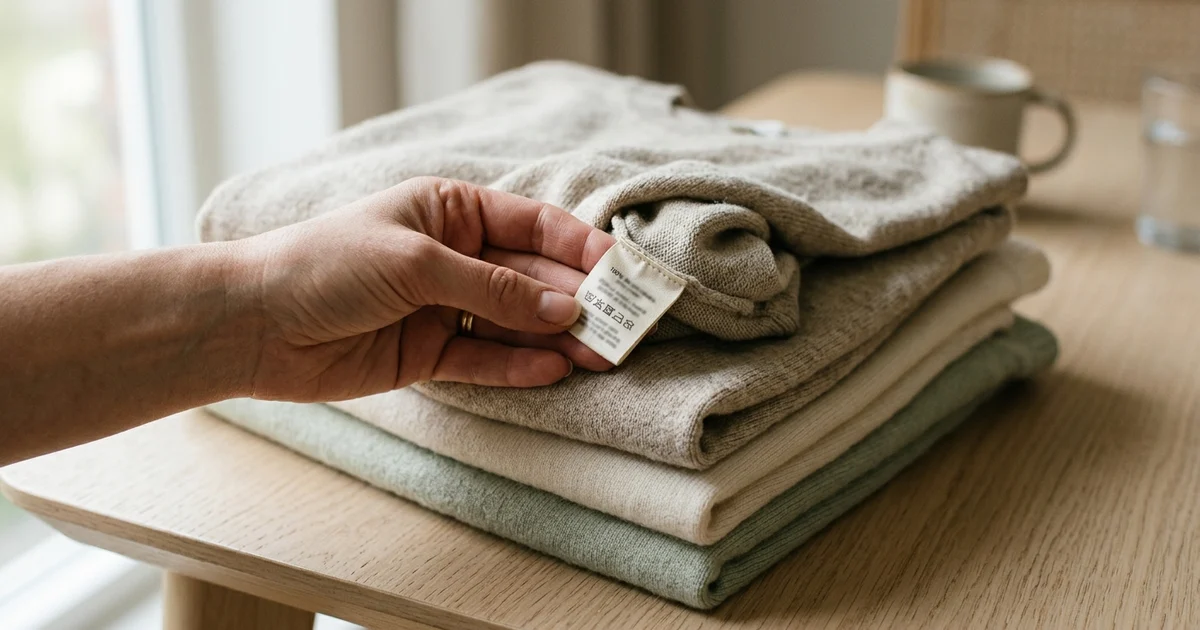
Find the content tag, usually in a side seam or at the neck, and look for one of these:
"Rayon" or "Viscose," with or without "made from bamboo." Compliant. You have semi-synthetic regenerated cellulose. This is the normal case.
"Lyocell" or "TENCEL Lyocell." Still manufactured, but made with the closed-loop process.
"100% Bamboo" with no fiber name. A red flag under 16 CFR 303. Either it is genuine mechanically processed bamboo, which the seller will usually be loud about because it is expensive, or the label is wrong. Ask the seller which process was used. A vendor selling real bamboo linen can answer that in one sentence.
No content tag at all. Fiber content disclosure is required for covered textile products. Its absence is itself information.
If you want to go further than fiber identity, How to Read Clothing Labels: Spotting Health Red Flags Before You Buy covers finishes and treatment claims, and How to Identify Any Fabric: 5 Simple Tests walks through the physical tests for when there is no tag left to read.
The Bottom Line
Bamboo viscose is not a natural fiber, and that is not a matter of opinion or marketing taste. It is a manufactured fiber under 16 CFR 303.7, the same regulation that governs polyester and nylon, and the label has to say rayon or viscose rather than bamboo. The FTC has enforced that rule against the largest retailers in the country four separate times since 2010. None of which makes bamboo viscose a bad fabric to own. It makes the word "bamboo" on a tag an unreliable guide to what you are holding, which is a different and more useful thing to know.
Scan Your Clothes — Know What You're Wearing
FiberCheck analyzes clothing labels and fabric photos instantly using AI, giving you health scores, chemical breakdowns, and safety insights in seconds. Make safer choices for your family.
Frequently Asked Questions
Is bamboo viscose a natural fiber?
No. It is a semi-synthetic, or regenerated cellulosic, fiber. The raw material is a plant, but the fiber itself is manufactured by dissolving cellulose and re-forming it chemically. 16 CFR 303.7 classifies rayon, which is what bamboo viscose is, as a manufactured fiber alongside polyester and nylon.
Are viscose and rayon the same thing?
Yes. The FTC states directly that viscose is the same thing as rayon. Rayon is the generic name used in US regulation; viscose is the process name and the term more common in Europe and Asia. A tag saying "100% viscose" and one saying "100% rayon" describe the same fiber.
Why can't a bamboo viscose product just be labeled "bamboo"?
Because there is no bamboo left in it. Under the FTC's rule, a textile may only be called bamboo if it is made directly from actual bamboo fiber. Anything made from cellulose that was dissolved and regenerated must carry the generic name rayon or viscose, optionally with "made from bamboo" added. Retailers including Kohl's, Walmart, Nordstrom and J.C. Penney have been ordered to pay civil penalties for ignoring this.
Is bamboo lyocell better than bamboo viscose?
On process chemistry, yes. Under 16 CFR 303.7 the lyocell route dissolves cellulose directly in an organic solution and forms no chemical intermediates, which means it skips the xanthate step that requires carbon disulfide. Both are still manufactured fibers, and neither is natural in the way cotton or linen is. Lyocell costs more, which is why most bamboo products on the shelf are viscose.
Does an OEKO-TEX certificate mean bamboo viscose is chemical-free?
No, and it does not claim to. OEKO-TEX STANDARD 100 tests the finished textile against limit values for harmful substances, with tighter limits for items in close skin contact. It says nothing about how the fiber was made, where it came from, or whether the production was sustainable. It is a useful signal about the finished object and a poor proxy for anything upstream of it.
Disclaimer: This article is for informational purposes only and does not constitute legal, medical or safety advice. It summarizes publicly available FTC guidance, regulations and enforcement announcements as of August 2026; regulations and case outcomes can change, and the primary sources linked above govern. If you experience skin irritation or an allergic reaction from any textile product, consult a qualified dermatologist. FiberCheck is a fabric analysis tool and is not a substitute for professional medical or legal guidance.