Is Acrylic Bad for Your Skin? What Actually Makes a Sweater Itch (2026)
Holding a sweater tag now? Scan it with FiberCheck to see the estimated fiber mix, including any acrylic, wool or cotton on the label, plus informational 0-10 score estimates such as Skin Safety and Breathability. The scan reads declared fibers and does not test the fabric.
Get FiberCheck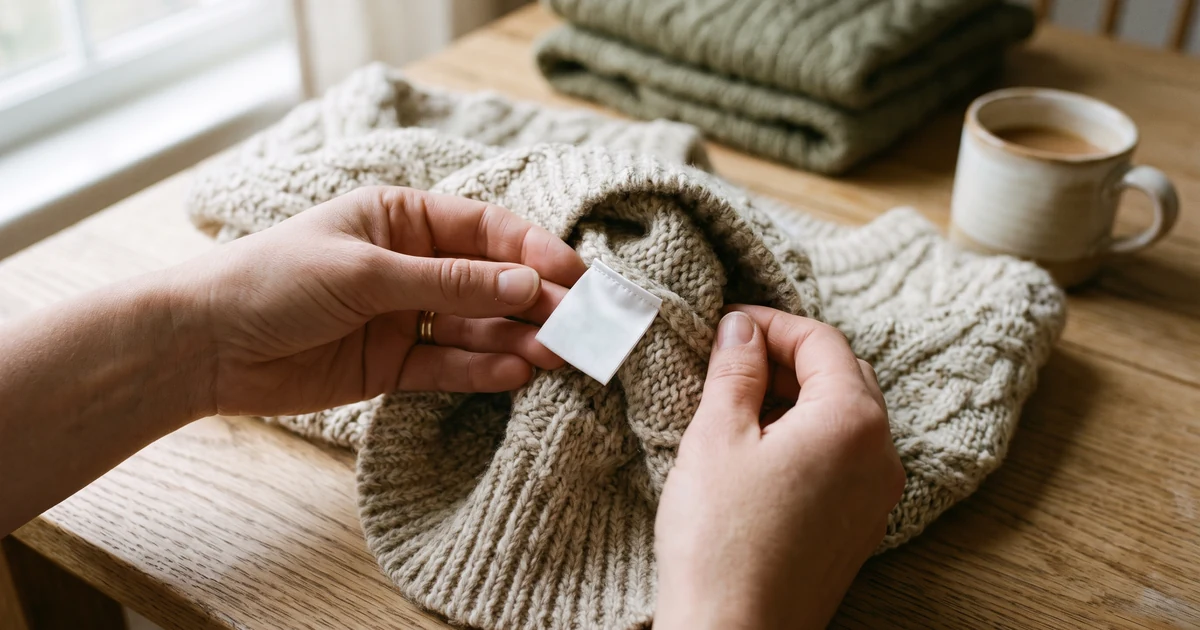
For most people, acrylic clothing is not known to harm the skin. When a sweater does bother you, dermatology sources point to heat and sweat, rough or tight fabric, and, for true allergy, dyes and finishes more often than the fiber.
The other worry is acrylonitrile, the chemical acrylic fiber is built from, which carries a cancer classification. Below, I go through what that classification covers, why a sweater can itch, and how to read a label before you buy.
Short answer: acrylic is not known to harm most skin
The question "is acrylic fabric good for skin" mixes three things: the fiber itself, how a garment fits and feels while you wear it, and what was added during dyeing and finishing. The dermatology sources below say a lot about the last two and nothing specific about acrylic itself. In my view, pulling them apart turns most of the worry into a few practical checks.
TL;DR: what matters with acrylic
- The fiber: none of the dermatology pages we read names acrylic, as a trigger or as a gentle option.
- The chemical: the International Agency for Research on Cancer (IARC) classified acrylonitrile as carcinogenic to humans. The human evidence came mainly from studies in workers producing or using it, and the evaluation was of the chemical, not of garments.
- Heat, sweat and fit: the American Academy of Dermatology (AAD) links overheating, sweat, rough-feeling fabric and tight clothing to eczema flare-ups, without naming a fiber.
- True allergy: DermNet says allergic reactions to clothing most often come from finishing resins, dyes and other additives, and rarely from fibers.
- New clothes: the AAD's eczema tips include washing them before you wear them.
What acrylic is, in the words of the label law
In the US, fiber names on clothing labels follow Federal Trade Commission rules. One of them, 16 CFR 303.7, defines acrylic as a manufactured fiber made from "any long chain synthetic polymer composed of at least 85 percent by weight of acrylonitrile units."
Two points follow from that definition.
- Acrylic is a polymer. It is a long chain built mostly from acrylonitrile units, and acrylonitrile is the chemical IARC evaluated. IARC describes it as "a volatile organic compound that is mainly used in the production of polymers."
- Modacrylic is a separate name. The same rule uses modacrylic for fibers with "less than 85 percent but at least 35 percent by weight of acrylonitrile units." It is a naming category, not a health grade.
The FTC's textile labeling guide for businesses explains how the fiber line is built. Fiber names and their percentages by weight are listed "in descending order of predominance." In general, fibers under 5 percent of the fiber weight are disclosed as "other fiber" or "other fibers."
So a tag that reads, say, "70% acrylic, 30% wool" tells you the main fiber and its share at a glance. What the fiber line does not tell you is which dye or which finish was used. For allergic reactions, that is where DermNet points.
The acrylonitrile question: what the cancer classification covers
This is the part that can sound alarming, so here it is in the agencies' own words.
IARC is the cancer agency of the World Health Organization. In Press Release No. 352, dated 5 July 2024, it reported: "The Working Group classified acrylonitrile as carcinogenic to humans (Group 1) on the basis of sufficient evidence for cancer in humans for lung cancer." The group also found "limited evidence in humans for bladder cancer." The release adds: "The evidence was mainly from studies in workers producing or using acrylonitrile."
The release lists uses of the polymers made from acrylonitrile, including "fibres for clothing, carpets, and other textiles," as well as plastics. On everyday exposure, it says: "The general population is exposed to acrylonitrile mainly via inhalation of cigarette smoke (including second-hand smoke)." It names air pollution as another source.
IARC also notes that the classification "does not indicate the level of cancer risk associated with exposure at different levels or in different scenarios." Put simply, Group 1 describes how strong the evidence is that a substance can cause cancer. It does not tell you how risky a particular exposure is, such as wearing a sweater.
The US Agency for Toxic Substances and Disease Registry (ATSDR) adds a second view in its ToxFAQs for acrylonitrile. It says you may be exposed through products that contain acrylonitrile, "such as acrylic fiber clothing or carpeting." The same page reports that the US Environmental Protection Agency has determined acrylonitrile is "a probable human carcinogen."
Here is how I read those two sources together:
- ATSDR lists acrylic clothing as a possible route of exposure. It gives no amount or risk for that route.
- For the general population, IARC's exposure section names cigarette smoke and air pollution. Clothing appears in its list of uses, not in that section.
- Neither source measures how much acrylonitrile, if any, reaches the skin from a finished garment, and neither says that wearing acrylic causes cancer.
So the honest answer is a gap in the evidence. It is not a finding of harm from wearing acrylic, and it is not a measured all-clear either.
Why an acrylic sweater can itch or irritate
The explanations below come from the AAD and from DermNet, a dermatology reference owned by the New Zealand Dermatological Society. None is specific to acrylic. They apply to any knit, acrylic included.
Heat and sweat. According to the AAD's atopic dermatitis skin care tips, "When you get overheated and sweat, the sweat can also trigger a flare-up." In my view, a heavy knit in a warm room is a heat question before it is a fiber question.
Rough feel and tight fit. The AAD's nummular eczema self-care page warns that "Rough-feeling fabric and tight clothing can irritate your skin, which can cause another flare-up." It suggests "loose-fitting clothing made of soft, breathable fabric." A scratchy yarn or a snug cuff can bother reactive skin whatever name is on the tag.
Additives, for true allergy. DermNet's page on textile contact dermatitis says: "Although all fibres can cause irritant and allergic contact dermatitis, it is rare for them to cause allergic contact dermatitis." It says allergic reactions to clothing are "most often a result of the formaldehyde finishing resins, dyes, glues, chemical additives and tanning agents used in processing the fabric or clothing." It also notes that the rash may get worse with constant rubbing from the fabric and with sweating in hot, humid conditions. DermNet's examples of synthetic fibers do not include acrylic, but its statement covers all fibres.
What the AAD lists, and what it leaves out. The nummular eczema page names specific fabrics: "Fabrics that can trigger a flare-up when they touch your skin include wool, polyester, rayon, nylon, acetate, latex, and spandex." Acrylic is not on that list, and none of the AAD pages we read names it. I would not read that silence as approval or as a warning.
Who is more likely to notice it
People with eczema-prone or sensitive skin. According to DermNet, "Anyone may be affected but people with atopic dermatitis or sensitive skin are at greater risk." The same page says textile contact dermatitis "is more common in women than in men." The areas most often affected, it says, are the places in most contact with clothing, such as the crooks of the arms, the backs of the knees and the armpits.
Reactions are individual. If one garment keeps leaving a rash in the same spot, that is worth showing to a board-certified dermatologist. The AAD's nummular eczema page puts it simply: "If you have spots and patches on your skin or the itch feels unbearable, a board-certified dermatologist can help."
Labels list fibers by percentage. FiberCheck reads the care label and shows the estimated blend, so you can see how much acrylic touches your skin before you buy.
Acrylic vs wool vs cotton for sensitive skin
If you are choosing between an acrylic sweater and a wool one, it is tempting to treat acrylic as the gentle option. The AAD pages we read do not name acrylic, so they do not support a ranking either way.
- The atopic dermatitis tips say: "Never wear wool next to your skin."
- The nummular eczema page lists wool among fabrics that can trigger a flare-up.
- The AAD's page on eczema-friendly products for children says: "Avoid wool and synthetic fibers like polyester, which can trigger eczema."
What the AAD does give you is a starting point. The atopic dermatitis tips say: "Wear loose-fitting 100% cotton clothing." The nummular eczema page says dermatologists recommend "wearing clothes made of cotton or labeled 'eczema friendly.'" So the AAD's default for flare-prone skin is cotton, not acrylic and not wool.
In my view, if wool bothers you, that is useful to know, but it does not make acrylic the answer by default. Fit, weight and how warm you will get are better tie-breakers than the fiber name. To compare more fabrics, see our ranked list of fabrics for sensitive skin.
Acrylic for babies and kids
The AAD's page for children with eczema is direct: "Dress your child in loose-fitting clothes made from 100% cotton. Avoid wool and synthetic fibers like polyester, which can trigger eczema." It names polyester as its example and does not mention acrylic. Under the FTC definition, though, acrylic is a manufactured fiber made from a synthetic polymer, so in my view the AAD's advice on synthetic fibers covers it too. For a child with eczema, the AAD starts with cotton.
The same page covers bedding, which matters if a knitted baby blanket is part of your question: "Sheets, comforters, blankets, pillowcases, and towels should be made of 100% cotton." It also says: "Wash towels and bedding before using." And it suggests talking with your child's dermatologist if you suspect your child "is sensitive to a dye found in food, clothing, or any other product."
That page is written for children with eczema. For babies without it, the pages we read give no acrylic-specific advice in either direction. For a wider look at fabrics for little ones, see our guide to baby fabrics.
How to check an acrylic piece before you buy
Here is the routine I would use.
- Read the fiber line. Fibers are listed by weight in descending order, so the first name is the main fiber. Note whether acrylic or modacrylic appears, and at what share.
- Check for wool if wool bothers you. Under the FTC's labeling guide, wool must be named with its percentage even when it makes up less than 5 percent.
- Think about fit and warmth. The AAD links tight clothing, overheating and sweat to flare-ups. In my view, a snug piece worn all day in a heated room deserves more thought than a loose layer.
- Wash it before the first wear. The AAD's eczema tips say: "Wash new clothes before wearing them." They also recommend laundry detergent that is "fragrance free and dye free."
- Scan the label. FiberCheck reads the care label, or a photo of the garment when there is no tag, and returns an estimated fiber mix with informational 0-10 score estimates. It works from what is visible on the label or in the photo. As the Google Play listing puts it, these estimates "cannot detect or measure chemical residues, verify that a product is safe, or predict an individual's reaction." So it can show you an estimated acrylic share. It cannot answer the acrylonitrile question.
- Track repeat reactions. If the same item keeps causing a rash where it touches, take that pattern to a board-certified dermatologist.
Washing acrylic: shedding is an environment question
One more acrylic question is about the wash, not the wearer. Imogen Napper and Richard Thompson studied it in a 2016 paper in Marine Pollution Bulletin. According to the University of Plymouth, they found that "an average washing load of 6kg could release an estimated 137,951 fibres from polyester-cotton blend fabric, 496,030 fibres from polyester and 728,789 from acrylic."
Acrylic had the highest estimate of the three fabrics tested. The fibers were collected from the machine's waste water, so this is a question about rivers and oceans, not about your skin. If that side of acrylic matters to you, here is what synthetic clothes shed in the wash.
Shopping knitwear or blankets? Scan the care label with FiberCheck for the estimated fiber mix and informational 0-10 score estimates, including Skin Safety and Breathability. Free to download on iOS and Android, with in-app purchases.
FAQ
Is acrylic fabric toxic to wear?
None of the agency or dermatology sources we read calls acrylic clothing toxic to wear. ATSDR does list acrylic fiber clothing as a possible route of exposure to acrylonitrile, but it gives no amount or risk for that route. The dermatology sources link skin problems to heat, sweat and rough or tight fabric; DermNet adds that any fiber can cause contact dermatitis, though allergy to clothing most often comes from finishes and dyes. If one garment keeps causing a rash, a board-certified dermatologist can help work out why.
Does acrylic contain acrylonitrile, and is that linked to cancer?
Under the FTC definition, acrylic is a manufactured fiber made from a polymer of at least 85 percent acrylonitrile units by weight. IARC classified the chemical acrylonitrile as carcinogenic to humans in 2024, on human evidence that came mainly from studies in workers producing or using it. ATSDR counts acrylic fiber clothing as a possible route of exposure, while IARC says the general population is exposed mainly through cigarette smoke, with air pollution as another source. Neither source says that wearing acrylic causes cancer, and neither measures exposure from clothing.
Is acrylic better than wool for eczema?
None of the AAD pages we read names acrylic, so they give no basis for ranking it above or below wool. The AAD's atopic dermatitis tips say never to wear wool next to your skin, and its page for children also says to avoid synthetic fibers like polyester. The AAD's default for flare-prone skin is loose 100% cotton clothing.
Is acrylic safe for babies?
The AAD's eczema page for children recommends loose 100% cotton clothes and 100% cotton bedding, including blankets. It says to avoid wool and synthetic fibers like polyester; it does not name acrylic, but under the FTC definition acrylic is made from a synthetic polymer. It also advises washing towels and bedding before use and talking with your child's dermatologist about a suspected dye sensitivity. For babies without eczema, the pages we read give no acrylic-specific advice either way.
Why does my acrylic sweater itch?
For eczema-prone skin, the AAD says rough-feeling fabric and tight clothing can irritate, and that overheating and sweat can trigger flare-ups. DermNet says fibers rarely cause allergic contact dermatitis, and that allergic reactions to clothing most often come from finishing resins, dyes and other additives. If a rash keeps coming back where a garment touches, see a board-certified dermatologist.
Disclaimer: This article is for informational purposes only and is not medical advice. FiberCheck did not test any products mentioned here. If you have a persistent rash, see a dermatologist.