Does Lululemon Have PFAS? What the Tests, the Company and Texas Say (2026)
Holding a pair? FiberCheck reads the care label and shows the fiber mix, a skin compatibility rating and a 0 to 10 health score.
Get FiberCheck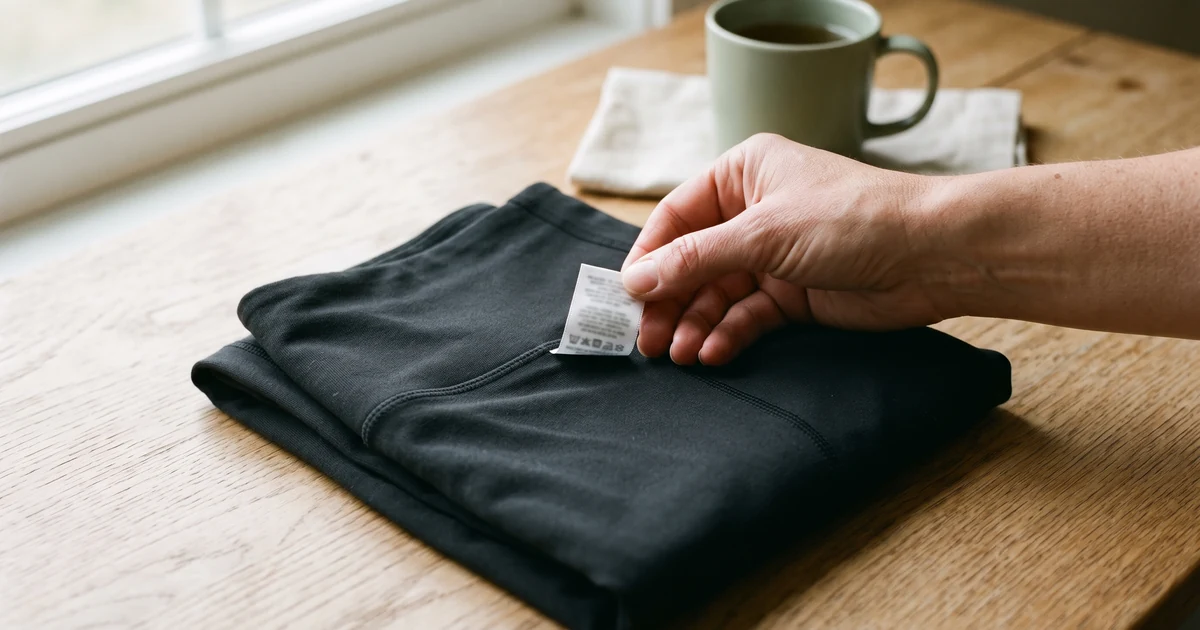
Does lululemon have PFAS? The public record cannot answer that for any specific pair, and a tag scan cannot either. An outside screen of activewear bought in 2021, reported in January 2022, found fluorine, a PFAS marker, in one pair of lululemon pants. The company says it does not use PFAS in products today. On October 22, 2026, after an April investigation, the Texas Attorney General announced an Assurance of Voluntary Compliance with lululemon. The agreement says the State's document review did not identify PFAS in lululemon products or materials, and that it is not an admission of any violation.
TL;DR:
- Tests: a consumer health site's screen found 32 ppm of total fluorine in one lululemon Align pant bought in 2021. That points to possible PFAS but does not prove it.
- Company: lululemon says it does not use PFAS in products today.
- Texas: an agreed compliance document with no payment terms and no admission. lululemon agreed to keep enforcing its vendor chemical rules for three years.
- You: no reason to panic, and no basis for a PFAS-free guarantee either.
Lululemon PFAS Tests: What the Outside Screen Found
The published lululemon test numbers we could find come from Mamavation, a consumer health and wellness site, not a regulator. Its activewear report discloses affiliate links and donations from Environmental Health News, and it says it has only spot-checked the industry, so it cannot make predictions about products it has not tested.
Environmental Health News reported on January 20, 2022 that Mamavation, partnering with EHN, tested 32 pairs of leggings and pants and found fluorine from 10 parts per million (ppm) up to 284 ppm in eight of them. The Lululemon Align Highrise Pant is on that list of eight. EHN says it partly funded the testing, and its write-up states that "the testing doesn't prove" PFAS are in the products.
Mamavation's activewear report, now dated September 22, 2026, gives the lululemon detail. It lists the Align Highrise Pant at 32 ppm of total fluorine and an Align High Rise Short with Pockets as non-detect. It says it placed the brand among the detections because fluorine was found in the first pair. The 284 ppm top reading belongs to another brand's leggings.
The method matters for reading that number. According to the report, the pairs were bought in 2021 and sent unopened to an EPA-certified lab, which it does not name. Each pair was screened for total fluorine by oxygen flask combustion and ion-selective electrode, with a detection limit of 10 ppm, and an organic fluorine test followed when fluorine turned up. The report has since grown to 42 pairs, with 10 added between 2023 and 2026.
A claim that blends two details
Some websites claim a Mamavation test found organic fluorine in the Align and that a class action followed. The Align does sit in a list the report heads as organic fluorine detections, but its own line reads 32 ppm total fluorine, with no organic fluorine figure, while several other brands get one. We also found no verified PFAS lawsuit (see the FAQ).
What Lululemon Says About PFAS
The company's position sits on its corporate site. A lululemon page dated April 16, 2026 states: "lululemon does not use PFAS in products today." It says that in apparel, PFAS "have historically been used in some durable water repellent products," the finishes that help fabric shed water.
The same page describes how the company says it keeps them out. lululemon has kept a Restricted Substances List, or RSL, since 2011. The page calls it the document that "outlines our standards for chemicals in products" and says it is updated annually. The company says it requires all vendors to regularly test for restricted substances, including PFAS, "by credible third-party agencies to confirm ongoing compliance." Its stated focus is to "help prevent the unintentional reintroduction of PFAS" into its products.
Read this for what it is: a company statement. The page gives no phase-out date, no testing threshold and no product test results. It also describes products today, so it cannot tell you whether a pair bought years ago was made under the same rules.
What Texas Did, and What It Did Not Do
An investigation, a lawsuit and an agreement are different things, and the office's own documents describe an investigation and then an agreement.
The investigation
In April 2026 the Texas Attorney General's office announced an investigation into whether lululemon "misled consumers about the safety, quality, and health impacts of its products," including the potential presence of PFAS. That is how the office summarizes it in its October 22, 2026 press release. The agreement itself dates the formal step a little earlier. According to the Assurance of Voluntary Compliance, the State issued a Civil Investigative Demand under the Texas Deceptive Trade Practices Act on March 26, 2026. The document says lululemon responded on time and cooperated.
The October 2026 agreement
The press release headline calls the outcome a settlement, and the document uses that word too. Its title is Assurance of Voluntary Compliance, or AVC. It is between the State of Texas and lululemon USA Inc. and is dated October 16, 2026. It was filed in a Collin County district court on October 19 with a request that the court approve it.
Under the AVC, lululemon agrees to keep requiring vendors to show that materials meet its RSL. Vendors can do that with test reports from a lab lululemon nominates or with valid third-party certifications; the document names bluesign and OEKO-TEX STANDARD 100 as examples. If a vendor's certificate expires or is not renewed, lululemon will require lab testing instead. lululemon will also keep requiring its designated lab to confirm that certifications submitted in place of testing are valid, to ensure materials comply with all PFAS-related RSL requirements. lululemon also agrees to take commercially reasonable steps to enforce vendor compliance with current and future versions of the RSL. The AVC ends automatically three years after it is entered.
The document is precise about how compliance is judged. For the main vendor obligation, it is measured by whether lululemon verifies vendor submissions and enforces its requirements, not by whether every vendor meets every RSL limit at all times. An isolated vendor failure is not, by itself, a breach, provided lululemon did not know of it when the materials were accepted, acts once it learns of it and has no pattern of failing to enforce the RSL.
What the AVC does not contain matters just as much. It has no payment terms; its only cost clause says the parties bear their own costs. It states that it "does not constitute an admission by lululemon of any violation of law," and that lululemon "expressly denies" liability. The one specific allegation it spells out concerns paperwork. The State alleges lululemon did not collect and keep signed RSL acknowledgement certificates from two vendors for one edition of the list, and the document says those have now been signed.
Then there is the line about PFAS. The AVC says that after "a review of the documents provided in response to its Civil Investigative Demand, the State did not identify PFAS in lululemon products or Materials." Read that narrowly. It describes a review of documents. The AVC does not describe the State testing any products itself, and it is not a certification that every lululemon item is PFAS-free.
Three more limits. The AVC releases the claims the State could have brought based on the facts it describes, but the press release does not say the investigation is closed. It says Attorney General Paxton "will continue to monitor Lululemon and ensure adequate material testing." The AVC creates no "private rights, causes of action, or remedies," so it holds no payout for shoppers. And it takes effect on the date the court signs it, which we could not confirm had happened at the time of writing.
What a Fluorine Reading Can and Cannot Tell You
A fluorine number is a screen, not a diagnosis. According to the EPA, there are thousands of PFAS chemicals. Mamavation's report explains why it screens for fluorine instead: only a limited number of PFAS compounds can be identified one by one in a lab. A total fluorine result can suggest fluorinated chemistry may be present. It does not name a compound or say how much of any specific PFAS is in the fabric.
Timing is the second limit. The lululemon pairs in the report were bought in 2021, years before the company's April 2026 statement. The screen does not describe pants made under lululemon's current rules. The only other lululemon result we found, in Mamavation's February 2022 sports bra guide, was a non-detect for a lululemon sports bra, and we found nothing newer.
The third limit is that the two sides measure different things. An outside screen reports one number for one sample. Under the AVC, lululemon's controls are vendor test reports and certifications checked against its RSL, and those reports are not published in the AVC. So the old screen and the company statement do not cancel each other out; they answer different questions about different samples, years apart. We took the same approach in our look at whether Alo Yoga has PFAS.
A care label lists fibers, not finishes. FiberCheck reads it and shows the fiber mix and a skin compatibility rating for your activewear.
Are Lululemon Leggings Toxic? What the Health Evidence Says
Most of the worry behind this question is about PFAS in general, so start there. According to the EPA, many PFAS are present at low levels in a variety of food products and in the environment. The agency says studies have shown that exposure to some PFAS in the environment may be linked to harmful health effects in humans and animals. How much people are exposed is one of the questions it lists as still being researched.
Clothing is a narrower question. The EHN write-up says that "it is unclear what exposure to PFAS through clothing means for humans." It also quotes Pete Myers, chief scientist of the group that publishes EHN, saying PFAS can be absorbed through the skin, but "we don't have much information about how much would be transferred from activewear products." None of the lululemon records, from the screen to the company page to the AVC, measured whether any PFAS moves from fabric to skin, or in what amount. So the record does not show that lululemon leggings are toxic, and it does not certify them as PFAS-free either.
That leaves a calm middle position: an old fluorine reading is a reason to ask questions, not proof of harm, and a company statement is some reassurance, not a guarantee. If you have a specific health concern, such as a skin condition or a pregnancy, a clinician is the right person to ask; a garment record cannot answer medical questions. For background on how PFAS end up in fabrics, see our guide to PFAS in clothing.
How to Read Your Own Leggings
Start with the label. It tells you the fiber mix, such as nylon and elastane, and how to wash the garment. It does not tell you whether a finish was applied or what chemistry that finish used. That is why an app, a label or a leggings tag cannot show whether a pair has PFAS.
Then think about what the item is for. lululemon's page ties past PFAS use in apparel to some durable water repellent products. EHN reported that experts told Mamavation that, in the flagged products, the chemicals were likely there as a stain, water or sweat wicking treatment, or through contamination from lubricants or cleaning chemicals used in manufacturing. So the question applies to plain leggings, not only to rain gear.
If you own lululemon pieces and want to think it through, a short checklist helps:
- Note roughly when you bought the item; the lululemon pairs in the outside screen were bought in 2021.
- Check whether the product is sold as water-repellent, since that is where the company says PFAS were historically used in apparel.
- Ask lululemon for test information on your exact style if it matters to you.
- Treat any online PFAS-free or toxic verdict with care unless it names the test, the product and the year.
For the brand's fabrics more broadly, see our guide to whether lululemon clothes are safe. That page covers the materials; this one covers the PFAS record.
The Bottom Line
The record comes down to three sources and one limit. An outside screen found 32 ppm of total fluorine in one lululemon Align pant bought in 2021, which points to possible PFAS but does not prove it. lululemon says it does not use PFAS in products today. Texas's October 2026 AVC commits lululemon to three more years of vendor chemical controls, contains no payment or admission, and says the State's document review did not identify PFAS in its products or materials. No one can certify a specific pair, so there is no reason to panic, and no basis for a PFAS-free label either.
Comparing leggings? Scan the care label with FiberCheck for the fiber mix, a skin compatibility rating and a 0 to 10 health score. Free to download on iOS and Android.
FAQ
Does lululemon have PFAS?
lululemon says it does not use PFAS in products today. An outside screen found fluorine, a PFAS marker, in one lululemon Align pant bought in 2021, but that screen does not prove PFAS and is years old. Texas's October 2026 agreement says the State did not identify PFAS in lululemon products or materials after reviewing documents.
Did lululemon get sued over PFAS?
We found no verified private or class action PFAS lawsuit against lululemon in news coverage and legal trackers, though we did not search court dockets. The Texas action is an Assurance of Voluntary Compliance, an agreed document filed in a Texas district court for approval rather than a contested case decided by a judge. It contains no payment terms and states that it is not an admission of any violation.
What did the Texas Attorney General announce?
On October 22, 2026, the office announced an Assurance of Voluntary Compliance with lululemon USA Inc. Under it, lululemon agreed to keep requiring vendors to show compliance with its Restricted Substances List through lab testing or valid certifications, for three years. The document states it is not an admission of any violation, and lululemon denies liability.
Are lululemon leggings toxic?
The public record does not show that they are. The outside screen measured fluorine, not health effects, and EHN noted it is unclear what PFAS exposure through clothing means for humans. The EPA says exposure to some PFAS may be linked to harmful health effects, so the question deserves attention rather than alarm.
Can a scanner app tell me if my leggings have PFAS?
No. An app, a label or a leggings tag cannot show whether a pair has PFAS; that takes lab testing of the specific product. FiberCheck reads the care label or a photo and shows the fiber mix, a skin compatibility rating and a 0 to 10 health score, not chemical content.
Disclaimer: This article is for informational purposes only and is not medical or legal advice. FiberCheck did not test any products mentioned here and is not affiliated with lululemon. Test results described here are as published by the parties named.