Is There PFAS in Your Kid's Raincoat or "Stain-Resistant" School Uniform?
Reviewed against two peer-reviewed studies on PFAS in children's textiles, the text of California's Assembly Bill 1817, and health guidance from the U.S. Agency for Toxic Substances and Disease Registry (ATSDR), current as of July 2026. Not medical advice.
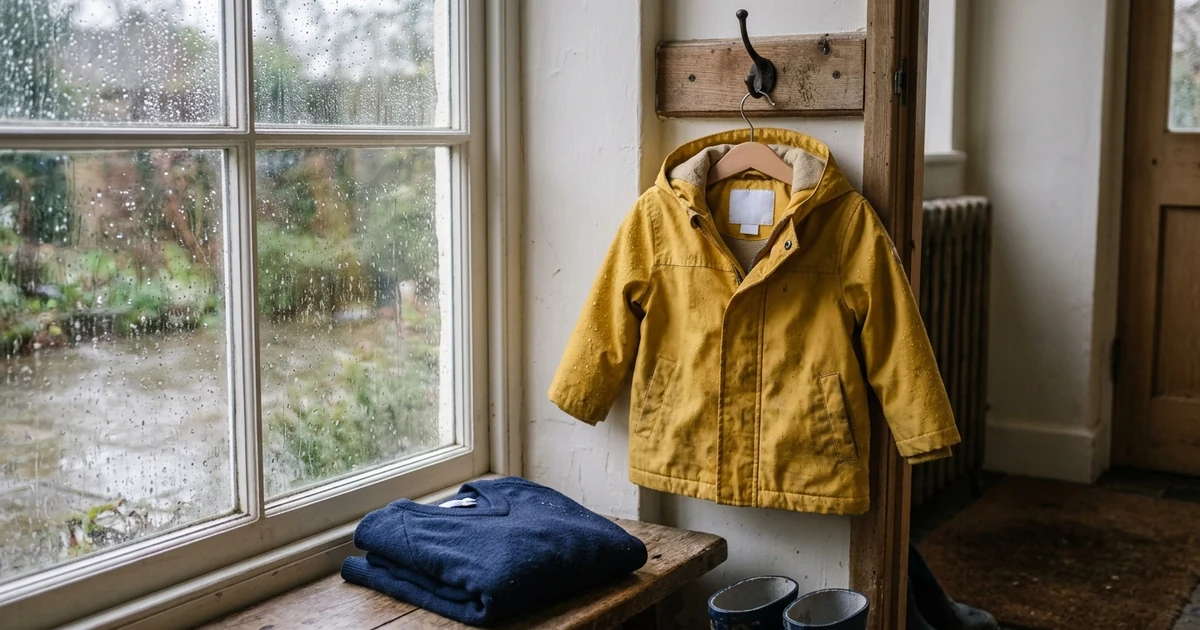
Most rain jackets, snowsuits, and school uniforms are fine to send your kid out the door in. Nothing here is a reason to strip the closet before Monday. But if you bought a rain jacket for its bone-dry-through-a-downpour promise, or a "stain-resistant" uniform shirt to stop pretreating grass stains, it is worth knowing what makes those promises true. Waterproof and stain-resistant performance almost always comes from a chemical finish, and one of the more common families used to build that finish is PFAS, the so-called forever chemicals.
This is the kids-specific branch of our broader guide on PFAS in clothing generally, and it sits alongside our reporting on PFAS in period underwear. Same chemical family, different corner of the closet: rainwear, snowsuits, and stain-resistant uniforms are where a water- or stain-repellent finish is the entire point of the product, which is exactly why the question deserves asking by name.
Why Rain Gear and "Stain-Resistant" Uniforms Are the Likely Vector
Waterproof and stain-resistant claims are not free. A fabric does not naturally shed rain or a ketchup stain; something has to be applied or engineered into it. According to the EPA's overview of PFAS, the carbon-fluorine bond that defines these chemicals is exactly what makes them useful for "stain and water-repellent" treatments "used on carpets, upholstery, clothing, and other fabrics," and it is also why they barely break down once made, the whole reason for the forever chemicals nickname.
That makes rainwear and stain-resistant uniforms a more direct case than most everyday apparel: the repellent function is not incidental, it is the reason the product exists and the reason a parent bought it. That does not mean every raincoat or uniform shirt is treated with PFAS specifically. Durable water repellent finishes can be built without fluorine chemistry, and plenty of brands have switched. But it does mean this category deserves a closer look than a plain cotton t-shirt would.
What Testing on Kids' Clothing Has Actually Found
Here we want real numbers, not a general impression, and two peer-reviewed studies give us something concrete.
A 2022 study in Environmental Science & Technology by researchers at the University of Toronto and Notre Dame, published in full via PubMed Central, tested 72 children's items and found detectable PFAS in every single one. School uniforms ranged from 0.283 to 153,000 nanograms per gram of fabric, median 728 ng/g. The dominant compound, 98 percent of the total measured, was 6:2 fluorotelomer alcohol, a variant common in durable water and stain repellents. Worth knowing when choosing fabric blends: pure cotton uniforms averaged roughly 19,100 ng/g in that dataset, versus about 1.7 ng/g for cotton-polyester blends, suggesting some manufacturers lean harder on treatment to make pure cotton hit a stain-resistant claim.
A separate 2022 study from Silent Spring Institute, published in the same journal and summarized in the organization's own reporting, tested 93 children's and adolescent products, including clothing, bedding, and furniture. Fifty-four of the 93, just over half, had detectable fluorine, and the single highest concentration in the entire study turned up in a school uniform shirt. Products labeled water-resistant or stain-resistant were far more likely to contain PFAS than products without those claims, even when marketed as "eco-friendly" or "non-toxic." The marketing language on the tag, in other words, was a poor predictor of what was actually in the fabric.
Rainwear itself has less dedicated testing than school uniforms, so we are not inventing a rain-jacket-specific percentage neither study measured. Both studies do establish, with real numbers, that PFAS shows up often in exactly the categories this article covers, and that school uniforms have turned up some of the highest readings recorded.
Before the next size-up buy, scan the label. Whether it is a new rain jacket or a replacement uniform shirt, FiberCheck flags PFAS and other chemicals of concern in about two seconds.
Open FiberCheckThe New Rules: What States Are Actually Doing
California's Assembly Bill 1817, the Safer Clothes and Textiles Act, is now in force, and it is worth getting precise here rather than repeating whatever bill number was in the news last year. Under the text of the bill itself, since January 1, 2025, no one may manufacture, distribute, sell, or offer for sale in California any new textile article, a category that explicitly includes apparel, containing regulated PFAS above 100 parts per million total organic fluorine, dropping to 50 ppm on January 1, 2027. One exemption matters for rain gear specifically: outdoor apparel rated for severe wet conditions gets until January 1, 2028 to comply, but must carry a visible "Made with PFAS chemicals" disclosure in the meantime if it contains them. That is a real, enforceable label to look for on a rain jacket tag today, not a future promise.
California was not the only state to move. Since 2025, several other states have passed or begun phasing in their own restrictions on PFAS in textiles and children's products, with effective dates staggered through 2026 and 2027. There is no single federal ban on PFAS in kids' clothing as of this writing, only a growing, uneven patchwork, which is why checking the specific item in front of you matters more than trusting a brand-wide policy.
How Worried Should You Actually Be
Proportion matters more than alarm here. PFAS health associations are real and well documented at the population level, but they come mostly from drinking-water and blood-level studies, not a precise, garment-by-garment dose measured for any specific rain jacket.
On the documented side, the U.S. Agency for Toxic Substances and Disease Registry (ATSDR), part of the CDC, associates PFAS exposure with increased cholesterol, lower antibody response to vaccines, changes in liver enzymes, pregnancy-induced hypertension and preeclampsia, small decreases in birth weight, and kidney and testicular cancer. Decreased fetal and infant growth is among the outcomes with the strongest evidence, part of why children's items get extra scrutiny at all, even though a rain jacket or snowsuit sits over other clothes rather than against skin for hours the way a base layer or period underwear would.
The school uniform research adds a concrete number rather than leaving it vague: a median dermal exposure from treated uniforms of about 1.03 nanograms of PFAS per kilogram of body weight per day, ranging up to 222 ng/kg per day in individual samples. That is a modeled estimate, not a measured blood level, and it sits well below the doses studied in most drinking-water contamination research: a real, non-zero exposure route worth reducing where reasonable, not a reason to treat a rain jacket like a hazard.
Who should be a little more careful than average? Younger children generally, given their higher skin-contact-to-body-weight ratio, the same reasoning behind the strictest certification tier for baby and toddler textiles, and anyone pregnant doing hands-on laundering of small children, given how often fetal and infant growth shows up on that list.
How to Read a Label Before You Buy Rain Gear or a Uniform
A few habits cover most of the practical ground here.
Check the OEKO-TEX class, not just the logo
OEKO-TEX STANDARD 100 certifies against more than 1,000 substances, but it is not one single bar. Product Class I, the strictest, applies only to items for babies and children up to age 3. Class II covers direct, extended skin contact, where a uniform shirt worn all day would sit. Class III covers items without direct contact, and a rain jacket over a shirt often falls here, meaning it can carry the OEKO-TEX name while meeting a less strict bar than the uniform underneath it. Seeing the logo is a good sign. Knowing the class is a better one.
Treat "stain-resistant" and "water-repellent" as a prompt to check, not a red flag by itself
The Silent Spring Institute research found these exact claims correlated with PFAS more than any other label language tested, including on items marketed as eco-friendly. That does not mean every stain-resistant tag hides PFAS. It means the claim is the signal to check, not to assume either way.
Look for the disclosure, where one applies
If you are buying rain gear rated for severe wet conditions, California's rule means a currently PFAS-treated jacket sold there must say so on the tag. A brand that discloses tells you more than one that stays silent.
Fiber blend can matter, but is not proof by itself
The uniform data above found pure cotton running far higher on average than cotton-poly blends in that one dataset. Use it as a reason to check a pure-cotton "stain-resistant" item more carefully, not as a blanket rule that blends are automatically clean.
If your bigger concern is general fabric safety for younger kids rather than this specific chemical family, our baby clothing safety guide covers the wider set of things worth checking on infant and toddler textiles.
Checking What Your Kid Already Wears
If your kid already owns a treated rain jacket or stain-resistant uniform, you do not need to replace everything in a panic.
Washing will not strip out a finish bonded into the fibers during manufacturing, though it is still good practice for a new garment before first wear. The more useful step is figuring out what is actually in the specific item you own, rather than guessing from a marketing claim or a brand's reputation. That is the gap FiberCheck is built to close: scan the fabric label, and it flags PFAS along with other chemicals of concern like formaldehyde and azo dyes, so you get an answer on the actual jacket or shirt in your hand instead of a category-wide guess.
Scan your kid's rain jacket or uniform label with FiberCheck before the next size-up buy, and know what you are actually replacing it with.
Try FiberCheck FreeThe Bottom Line
Rain jackets, snowsuits, and stain-resistant school uniforms are not recalled categories, and nothing here should make you anxious about what is already in the closet. But waterproof and stain-resistant performance is a chemical claim, not just a marketing flourish, and PFAS is a well-documented way manufacturers have delivered it. Two peer-reviewed studies found PFAS in the large majority of children's textiles tested, with school uniforms turning up some of the highest readings recorded, and stain-resistant or water-repellent labeling was itself a strong predictor of PFAS presence regardless of "eco-friendly" claims on the same tag. California's textile law is now active and requires disclosure on treated rain gear sold there, with other states phasing in related rules through 2026 and 2027. The practical move is to check the OEKO-TEX class rather than just the logo, take the disclosure label seriously where one applies, and scan the specific item your kid is actually wearing.
Scan Your Clothes — Know What You're Wearing
FiberCheck analyzes clothing labels and fabric photos instantly using AI, giving you health scores, chemical breakdowns, and safety insights in seconds. Make safer choices for your family.
Frequently Asked Questions
Is my kid's raincoat safe to wear?
Most likely yes for everyday wear, with no recall on the category. The honest caveat is that waterproof performance is a chemical claim, and testing on similar children's textiles has found PFAS often enough that checking the specific jacket beats trusting the brand.
Do all "stain-resistant" school uniforms contain PFAS?
No, but stain-resistant and water-repellent labeling correlates strongly with PFAS in research, and one 2022 study found its single highest concentration in a school uniform shirt. Not every uniform is affected, but the label is a prompt to check, not a guarantee.
What US laws actually restrict PFAS in kids' clothing right now?
California's Assembly Bill 1817 has been in force since January 1, 2025, capping PFAS in textile articles, including apparel, at 100 ppm total organic fluorine, dropping to 50 ppm in 2027. Severe-wet-condition rain gear gets until 2028 but must currently disclose if it contains PFAS. Several other states are phasing in related restrictions through 2026 and 2027.
How can I tell if a rain jacket or uniform has PFAS in it?
You cannot tell by touch, and a "stain-resistant" or "waterproof" tag does not confirm it either way. Check for an OEKO-TEX STANDARD 100 certification and its product class, look for a required PFAS disclosure where state law applies, or scan the label with FiberCheck for a specific answer.
Should I be extra careful with infants or during pregnancy?
A little, yes. Decreased infant and fetal growth is one of the PFAS outcomes with the strongest evidence, and younger children have a higher skin-contact-to-body-weight ratio than adults, the same reason baby and toddler textiles carry the strictest certification tier. That is worth a bit more label-checking, not a reason to panic about a rain jacket worn over a shirt.
Disclaimer: This article is for informational purposes only and does not replace consultation with a qualified healthcare provider. It summarizes publicly available peer-reviewed research, official legislative text, and health guidance current as of July 2026. References to the EPA, ATSDR, Silent Spring Institute, the cited research team, the California legislature, and OEKO-TEX are for attribution only; this article is not endorsed by or affiliated with those organizations. FiberCheck is a clothing-analysis tool and is not a substitute for professional medical diagnosis, treatment, or laboratory testing.