Are Primark Clothes Safe? What Testing Shows (2026)
TL;DR - Key Takeaways
- Primark is a budget high-street brand. Like all fast fashion it carries some chemical-exposure considerations, but it is not inherently "toxic."
- Primark sells in the EU, UK, and Ireland (as Penneys), where products must comply with REACH restrictions on hazardous substances.
- The company runs a "Primark Cares" programme with commitments around sustainably sourced cotton and recycled materials.
- Synthetic-heavy ranges, coated items, and printed designs still warrant the same washing and label-reading habits as any budget clothing.
- Practical rules at the bottom of this guide apply to any Primark purchase, and you can scan any label with FiberCheck for a quick read.
Are Primark clothes safe? It is a fair question for any budget retailer, and Primark sits in an unusual spot. It is famous for very low prices and high volume, sold mostly in physical stores across the UK, Ireland (where it trades as Penneys), and the rest of Europe, with only limited online presence. Low price makes shoppers wonder what was cut, so it is worth separating what is regulated, what is genuinely a category-level risk, and what is just budget-fashion anxiety.
The balanced answer is that Primark is not inherently unsafe. It operates under EU and UK chemical regulation, publishes restricted-substance and sustainability commitments, and sells through a regulated high-street model rather than an opaque marketplace. At the same time, fast fashion in general involves dyes, finishes, and synthetic materials that reward sensible habits. This guide covers both sides without inventing lab results that do not exist.
The Chemical Concerns in Budget Fast Fashion Generally
These are category-level risks that apply across budget fast fashion, not confirmed Primark-specific lab findings. Knowing them tells you which items deserve extra attention on any high-street rail.
Azo dyes
Azo dyes are among the most common textile colourants. A subset of restricted azo dyes can break down into aromatic amines that are banned under REACH in the EU and UK. Regulation limits these in clothing sold in those markets, but heavy dye loads and items that bleed strongly in the wash are still worth treating with caution. Our guide to harmful chemicals in clothing explains where these most often appear.
Formaldehyde-based finishes
Formaldehyde resins are used to make garments resist wrinkling and creasing during shipping and display. They can trigger skin irritation or contact dermatitis in sensitive people. A sharp chemical smell on a new "easy-care" item is a practical early-warning signal. See our full guide to formaldehyde in clothing.
Residual processing chemicals
Textile production uses solvents, softeners, and other processing aids, and traces can remain on a finished garment until it is washed. This is normal across the industry rather than unique to any one retailer, and a first wash removes a meaningful portion of it.
PFAS in water-repellent items
PFAS, often called "forever chemicals," are used to create stain-resistant and water-repellent finishes on some outerwear and performance items. They are persistent and increasingly restricted by regulators. If a budget item promotes water-repellent performance, it is reasonable to ask how that finish was achieved. Our PFAS in clothing guide covers this in detail.
Phthalates in prints and PVC trims
Phthalates are plasticisers that keep printed graphics, glossy designs, and PVC or faux-leather trims flexible. Several phthalates are restricted in children's products under EU and UK rules. The concern concentrates in plasticised prints and coated items rather than plain woven fabric.
Crucially, none of the above is a claim that a specific Primark item contains these substances above legal limits. They are the risk categories textile-safety standards focus on, and they tell you which items to look at more closely on any budget rail.
👆 Try it yourself — Scan your own clothes with FiberCheck (Free)
The Regulatory and Sustainability Context
This is where Primark differs meaningfully from an ultra-fast fashion marketplace. Primark is a regulated high-street retailer selling in the EU, UK, and Ireland, so its products must comply with REACH, the EU and UK regulation that restricts hazardous substances in consumer goods, including certain azo dyes and restricted phthalates.
Primark also publishes chemical-management and restricted-substance commitments and participates in sustainability initiatives. According to its published commitments, suppliers are expected to meet Primark's restricted-substances and product-safety standards. We use measured language here on purpose: Primark states these positions publicly, and they describe a compliance framework rather than a per-item lab certificate you can look up yourself.
On the sustainability side, Primark runs its "Primark Cares" programme, which includes commitments around sustainably sourced cotton and the use of recycled materials in some ranges. These are environmental and sourcing commitments more than direct chemical-safety guarantees, but they indicate a retailer operating inside a regulated framework with public targets, which is easier to hold accountable than an anonymous online seller.
The Categories Worth Checking First
Even within a regulated retailer, some categories carry more chemistry than others. These are the items to slow down on.
Kids and baby ranges
Children's clothing is regulated more tightly than adult clothing, with stricter thresholds for restricted substances, flammability, and small parts. That regulation works in your favour, but babies still have thinner skin and more hand-to-mouth contact, so plain natural-fibre items are worth prioritising. Our baby clothing safety guide covers what to look for.
Faux leather and coated items
Faux-leather jackets, skirts, and accessories use coatings and plasticisers to stay flexible, which is where phthalate and PVC concerns concentrate. Adult faux-leather accessories are lower priority than children's coated items, but both are worth a quick label check.
Glittery, sequinned, and printed party wear
Glitter, sequins, and heavy plastisol or graphic prints rely on plasticisers and adhesives. Strong chemical odour on a printed or glittery item, especially when it is brand new, is a practical reason to wash it first or reconsider the item.
Water-repellent outerwear
Any item marketed as water-repellent or splash-proof at a budget price raises the PFAS question. It does not prove PFAS is present, but it is a category to be aware of, particularly for children's rainwear.
Very cheap synthetics worn next to the skin
Base layers, underwear, and fitted tops sit against the skin for long stretches, so fabric choice matters more here. Simple cotton or other natural fibres are lower-complexity options than heavily finished synthetic blends.
Practical Safer-Shopping Rules
None of these guarantees a perfect garment, but together they reduce worst-case exposure on any Primark purchase.
Wash new clothes before first wear
A first wash removes loose dye, surface finishing residues, and packaging off-gassing. It is the single easiest habit that lowers initial exposure. Our wash-new-clothes guide explains why this matters most for finished and synthetic items.
Prefer natural fibres or OEKO-TEX where available
Plain cotton, linen, and other natural fibres are lower-complexity choices for high skin-contact items. If a range carries OEKO-TEX labelling, that is stronger evidence of chemical screening than generic "soft" or "skin-friendly" wording.
Avoid strong-chemical-smelling items
A sharp, plasticky, or solvent-like odour that lingers after airing the item out is a reason to wash first or leave it. Smell is not proof of a problem, but it is a useful signal.
Check labels for fibre content
A 100% polyester item carries different chemical considerations than a cotton-linen blend. If the label is clear, you can make a more informed call; vague or missing fibre content is a transparency flag.
Be cautious with baby, printed, and coated items
Raise your standards for infant basics, heavy plastisol prints, glittery party wear, and faux-leather or coated pieces. For babies, prioritise plain natural-fibre items and wash everything before use.
How FiberCheck Reads a Primark Label
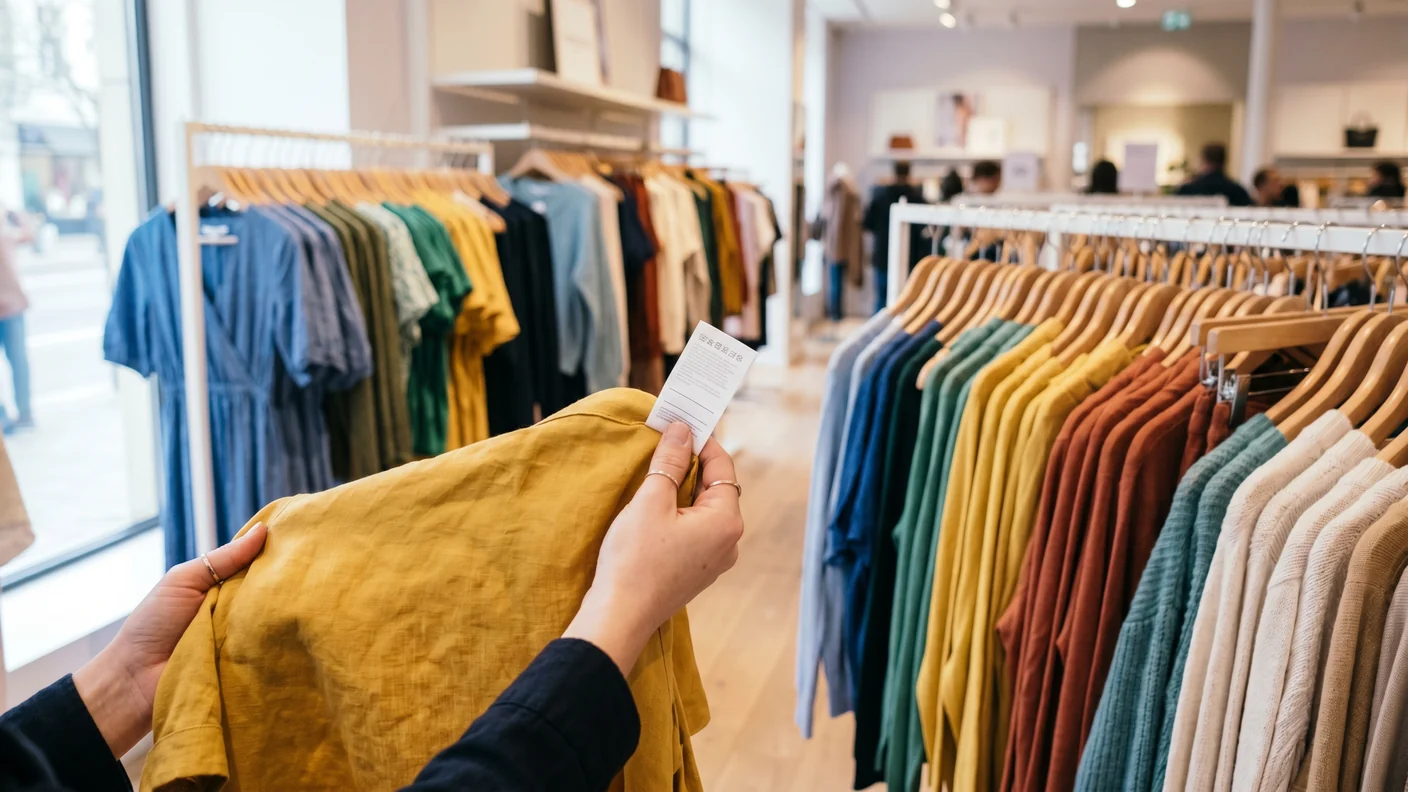
Primark sells mostly in store, so the physical tag in your hand is the authoritative source of information about a garment. That is exactly what FiberCheck is built to read.
Scan any clothing label with the app and FiberCheck uses AI to read the fibre content, care symbols, and any certification language on the tag, then gives you a fabric composition and a health and safety read in seconds. A label showing 100% polyester with a water-repellent finish sits in a different risk pattern than 100% cotton with no special finishing, and the app surfaces that distinction for you.
One important caveat: this analyses the label, it is not a lab test. FiberCheck reads what is declared and flags where the information matches known risk patterns. It is a fast screening tool to help you decide what to buy, what to wash first, and what to skip, not a replacement for laboratory testing or regulatory certification.
Primark vs Shein and Temu
People often lump Primark in with online fast-fashion giants, but the comparison is not like for like. Primark is a regulated EU, UK, and Ireland high-street retailer that sells mostly through physical stores and answers to local consumer-protection and chemical regulators in those markets.
Shein and Temu are ultra-fast-fashion online marketplaces where many items ship directly from individual sellers and product-level certification is much harder to verify. Our Shein safety guide and Temu safety guide cover those marketplace dynamics in detail.
The practical takeaway: a regulated high-street chain is generally easier to hold accountable than an anonymous online seller. But no retailer earns blind trust. The same routine applies everywhere: check the fibre label, prefer natural fibres or OEKO-TEX where available, avoid strong-smelling or heavily coated items, and wash before wear.
When Primark Is Genuinely Fine
Plenty of Primark clothing is a reasonable low-risk buy. The platform is not uniformly high-risk, and several categories carry low chemical-exposure concerns:
- Plain natural-fibre basics: undecorated cotton t-shirts, socks, and base layers without heavy coatings or prints are a sensible everyday choice, especially after a first wash.
- Regulated kids' essentials: children's clothing benefits from tighter regulatory thresholds, so plain cotton kids' basics are a reasonable buy with the usual wash-before-wear habit.
- Accessories without skin contact: bags, hats with woven bands, and similar items have limited prolonged skin contact, which lowers the chemical-exposure concern.
Price alone does not determine risk. A plain certified basic is low-risk regardless of how cheap it is, while a heavily coated or printed item warrants more attention at any price. The signal is the item type and the label, not the price tag.
The Bottom Line
Are Primark clothes safe? Broadly yes, with the usual fast-fashion caveats. Primark is a regulated EU, UK, and Ireland high-street brand operating under REACH, with published restricted-substance and "Primark Cares" sustainability commitments. It is not inherently toxic. The category-level risks common to budget fashion, like formaldehyde finishes, PFAS coatings, and plasticised prints, still reward sensible habits: read the label, prefer natural fibres, avoid strong-smelling and coated items, and wash before wear. Drop a photo of any Primark label into FiberCheck and we will flag the risk patterns for you in seconds.
Scan Your Clothes — Know What You're Wearing
FiberCheck analyzes clothing labels and fabric photos instantly using AI, giving you health scores, chemical breakdowns, and safety insights in seconds. Make safer choices for your family.
Frequently Asked Questions
Are Primark clothes toxic?
There is no basis to call Primark clothing toxic as a blanket statement. Primark sells in the EU, UK, and Ireland, where products must comply with REACH restrictions on hazardous substances, and the company publishes restricted-substance commitments. Like all fast fashion, individual items can still carry residual processing chemicals, dye residues, or finish treatments, so the same washing and label habits apply. Toxic is the wrong frame; reasonable caution with synthetic-heavy and coated items is the right one.
Is Primark safe for babies and kids?
Primark sells a large baby and kids range, and children's clothing sold in the EU and UK is subject to tighter chemical and safety thresholds than adult clothing, including rules on flammability, small parts, and restricted substances. That said, babies have thinner skin and more hand-to-mouth contact, so it is still worth choosing plain natural-fibre items where possible, avoiding heavy plastisol prints and coated trims, and washing everything before first wear. Look for OEKO-TEX labelling on items meant for infants when you can find it.
Does Primark use harmful chemicals?
All textile production involves chemicals: dyes, finishes, and processing aids. Primark states it operates a restricted-substances programme and complies with EU and UK chemical regulation, which limits substances such as certain azo dyes and restricted phthalates. That reduces but does not eliminate the category-level risks common to budget fast fashion, like formaldehyde-based wrinkle finishes, PFAS in water-repellent items, or plasticisers in printed designs. The honest answer is that some chemicals are present in any garment, and regulation plus good laundry habits are what keep exposure low.
Is Primark clothing tested for safety?
According to its published commitments, Primark requires suppliers to meet its restricted-substances and product-safety standards and works within EU and UK regulatory frameworks. Product-level chemical testing of textiles is generally handled through supplier compliance and restricted-substance lists rather than a public per-item certificate you can look up. This means you usually cannot verify an individual garment's lab results yourself, which is exactly why reading the fibre label and washing before wear remain practical defaults.
Are Primark clothes safe to wear without washing?
It is better to wash any new clothing before first wear, Primark included. A first wash removes loose dye, surface finishing residues, and packaging-related off-gassing that can build up in transit and storage. This is not a Primark-specific warning; it applies to budget and premium clothing alike. For anything worn close to the skin, like underwear, base layers, or baby items, washing before wear is a sensible default.
Is Primark more or less safe than Shein or Temu?
These are different kinds of retailer. Primark is a regulated EU, UK, and Ireland high-street chain that sells mostly in physical stores and answers to local consumer-protection and chemical regulators in those markets. Shein and Temu are ultra-fast-fashion online marketplaces where many items ship directly from sellers and product-level certification is harder to verify. A regulated high-street retailer is generally easier to hold accountable, but the safest approach with any of them is the same: check the fibre label, prefer natural fibres or OEKO-TEX where available, avoid strong-smelling or heavily coated items, and wash before wear.
Disclaimer: This article is for informational purposes only and does not constitute medical or legal advice. It summarizes publicly available consumer-safety concerns, certification standards, and regulatory frameworks as of June 2026, and describes category-level risks rather than lab-verified findings for any specific Primark product. If you experience a rash, allergic reaction, or any health issue related to clothing, consult a qualified clinician. FiberCheck is a clothing-analysis tool and is not a substitute for professional medical guidance or laboratory testing.